Zig-Zag Air Classifier: Removing Labels, Paper and Dust from PET and HDPE Flakes
Your flakes can pass every washing and density-separation step and still come out dirty — with paper labels, film fines, and dust clinging to them. Those contaminants are too light for sink-float tanks and too small for screens. A zig-zag air classifier removes them with the one property they cannot hide: they weigh almost nothing. This guide covers how the machine works, where it belongs in the line, and how its settings are tuned.
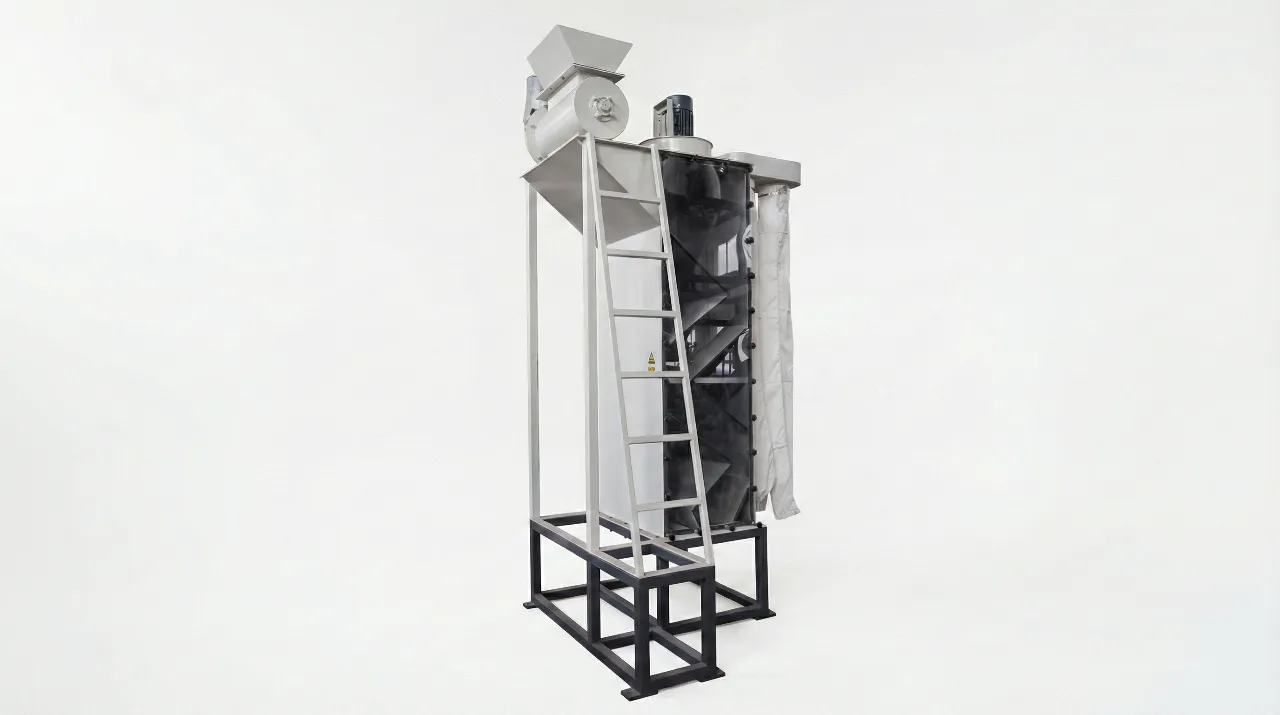
How a Zig-Zag Air Classifier Works
Material enters a vertical column folded into a zig-zag path. A controlled air stream rises through the column. Dense PET, HDPE, or PP flakes are too heavy for the airflow and cascade downward from bend to bend until they discharge at the bottom. Light fractions — paper labels, film fines, fibers, and dust — are carried upward, collected through the top hood, and routed to a cyclone and dust filtration.
The zig-zag shape is the point. A straight column gives the air one chance to separate; the folded path makes the material tumble and re-present itself at every bend, so flakes that were shielding a label fragment at one stage release it at the next. Separation quality comes from repetition, not just air power.
- Removes: paper and label fragments, film fines, fibers, dust, and other light fractions
- Keeps: dense PET, HDPE, and PP flakes, discharged clean at the bottom
- Does not remove: heavy contaminants of similar density to the flake — that is the job of sink-float separation and metal separators upstream
Where It Sits in the Line
Position matters more than size. The classifier is typically installed after drying, when flakes are free-flowing and light contaminants are no longer stuck to wet surfaces. Run damp material through it and the labels simply ride down with the flakes they are glued to. Placed correctly — after the dryer, before packing or pelletizing — it is the final polishing step that lifts flake purity to the grade buyers pay premiums for. The vertical column also helps in tight plants: it integrates above conveyors or on a mezzanine instead of eating floor space.
Tuning the Cut Point
The separation threshold — the "cut point" — is set by fan speed and damper position. Raise the airflow and more material lifts: purity rises, but push too far and good fine flakes start leaving with the reject stream. The correct setting depends on the polymer, bulk density, flake geometry, and moisture, which is why the adjustment range matters more than any single factory preset. In practice, operators tune against a simple loop: check the top outlet for good flakes (airflow too high) and the bottom outlet for labels (airflow too low), then settle between the two.
Sizing and Practicalities
| Item | Typical specification |
|---|---|
| Throughput range | Roughly 300–3,000 kg/h, sized by polymer, bulk density, flake geometry, moisture, and contaminant load |
| Sizing variables | Column cross-section and height, number of stages, blower curve |
| Dust handling | Light fraction routed to a cyclone, then a baghouse or cartridge filter; sealed ducting under slight negative pressure |
| Product-contact surfaces | Stainless steel — 304 standard, 316 optional; clean-out doors and inspection windows fitted |
| Routine maintenance | Inspect fan bearings, rotary valve blades, and dust collection points |
Rumtoo's zig-zag air classifier for plastic recycling follows this pattern: an adjustable airflow profile matched to the polymer and contamination load, in a compact vertical footprint with minimal moving parts.
Send your material type, bulk density, throughput, and line layout. Our engineers will size the column and airflow profile for the purity target you need.
See the Zig-Zag Air Classifier


Comments
Post a Comment