Plastic Film Densifier: Why Washed Film Should Be Densified Before Pelletizing
Washed plastic film is one of the most awkward materials in recycling: it leaves the washing line wet, fluffy, and so light that a cubic metre of it weighs less than a bag of cement. Feed it to a pelletizing extruder in that state and the screw starves, surges, and plugs. A film densifier exists to fix exactly that — turning washed film into dense, dry, free-flowing granules the extruder can actually eat. Here is what it does and how to choose a model.
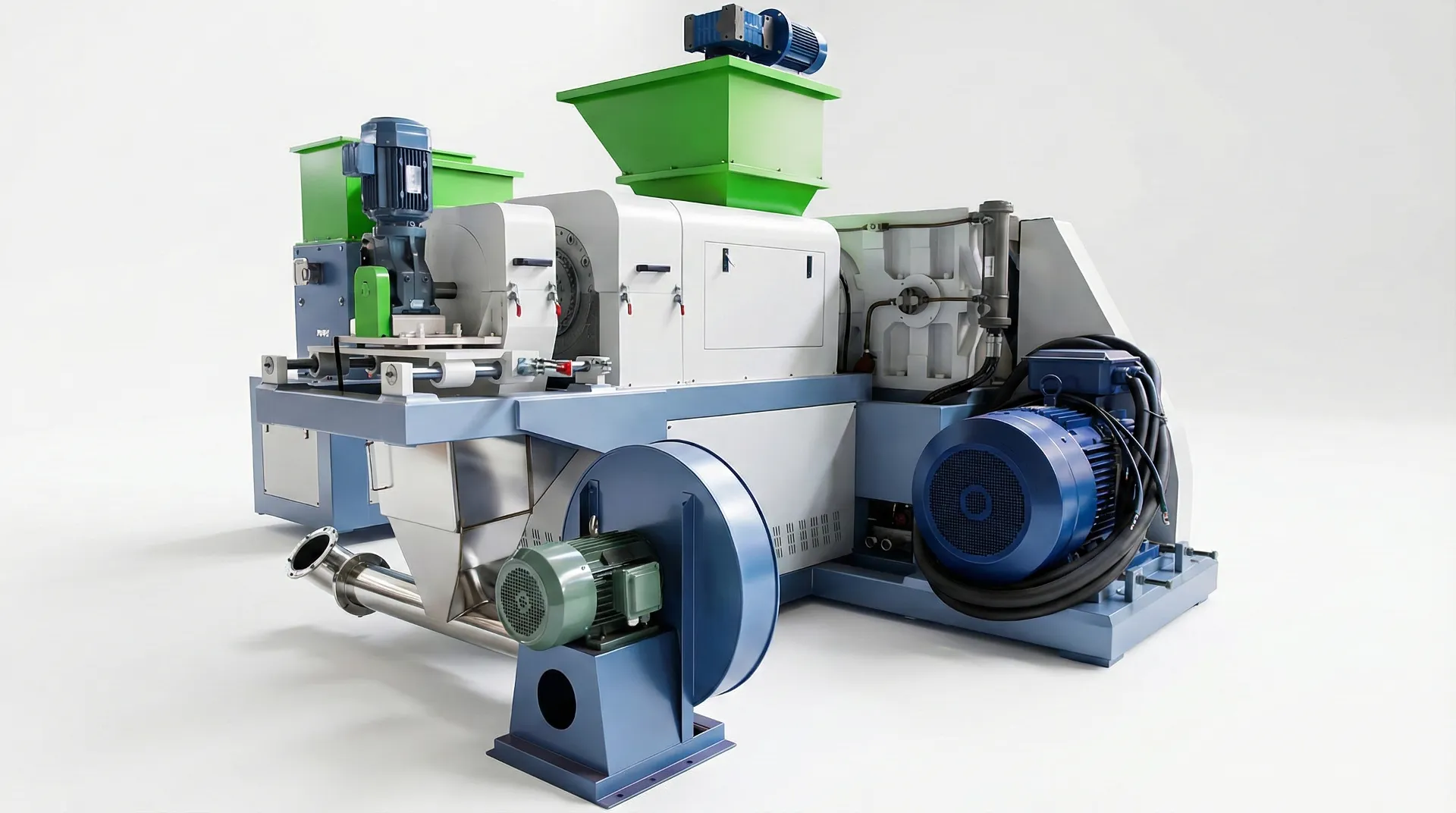
What a Screw Densifier Does to Washed Film
Rumtoo's densifier design is built around a heavy-duty alloy screw working inside a slotted dewatering barrel, finished by a die-face cutter. Wet film enters; the screw compacts it and forces water out through the barrel slots under pressure — mechanical dewatering, not evaporation — while friction heat drives off residual moisture. The compacted material is then cut into granules by a rotary hot cutter with VFD speed regulation.
- Bulk density: from 30–50 kg/m³ (fluffy film) to 250–350 kg/m³ — a 5–8× increase
- Final moisture: 1–3%
- Downstream effect: dense, dry feed prevents bridging and screw slippage in the pelletizer, lifting extrusion throughput by roughly 20–30%
That last point is the real return on the machine. A pelletizer fed on fluffy film spends its life alternating between starvation and surging, and output quality follows the same rhythm. Fed on densified granules, it runs at a steady rate — which is why the densifier belongs immediately between the washing line and the pelletizing line, not as an optional extra. Rumtoo's plastic film densifier is engineered for that position, integrating directly with both.
Choosing a Model
Match the densifier to the washing line's output and the pelletizer's appetite — it should never be the bottleneck, and oversizing wastes motor power on every tonne:
| Model | Capacity | Main Motor | Final Moisture | Notes |
|---|---|---|---|---|
| RT-D300 | 300–500 kg/h | 90 kW | 1–3% | Compact, fits small lines |
| RT-D500 | 500–800 kg/h | 132 kW | 1–3% | Best-seller for PE film |
| RT-D800 | 800–1,200 kg/h | 185 kW | 1–3% | High-throughput, stable feeding |
| RT-D1200 | 1,200–1,500 kg/h | 220–250 kW | 1–3% | Large line integration |
Densifier or Pot Agglomerator?
The two are often confused, and they solve different problems. The screw densifier described here is for washed, wet film: its first job is dewatering, and densifying comes with it. A traditional pot agglomerator — a vertical pot with high-speed rotating blades at the bottom — is for dry material such as industrial film rolls, clean edge trim, and fiber waste that needs densifying but has no water to remove. Rumtoo manufactures both systems; the deciding question is simply whether your film comes off a washing line or arrives dry.
Share your material, moisture level after washing, and target throughput. We will match a densifier model to your washing and pelletizing lines.
See the Plastic Film Densifier


Comments
Post a Comment