Guillotine Cutter vs Shredder: The Right Way to Open Bales and Pre-Cut Film
Most film and bottle recycling lines do not fail at washing or pelletizing. They struggle at the very first step: the material arrives as dense, wire-tied bales, and someone has to turn a one-tonne compressed block into a loose, steady feed stream. Two machines get proposed for that job — the hydraulic guillotine cutter and the shredder — and choosing the wrong one is expensive in both directions. Here is how they actually differ.
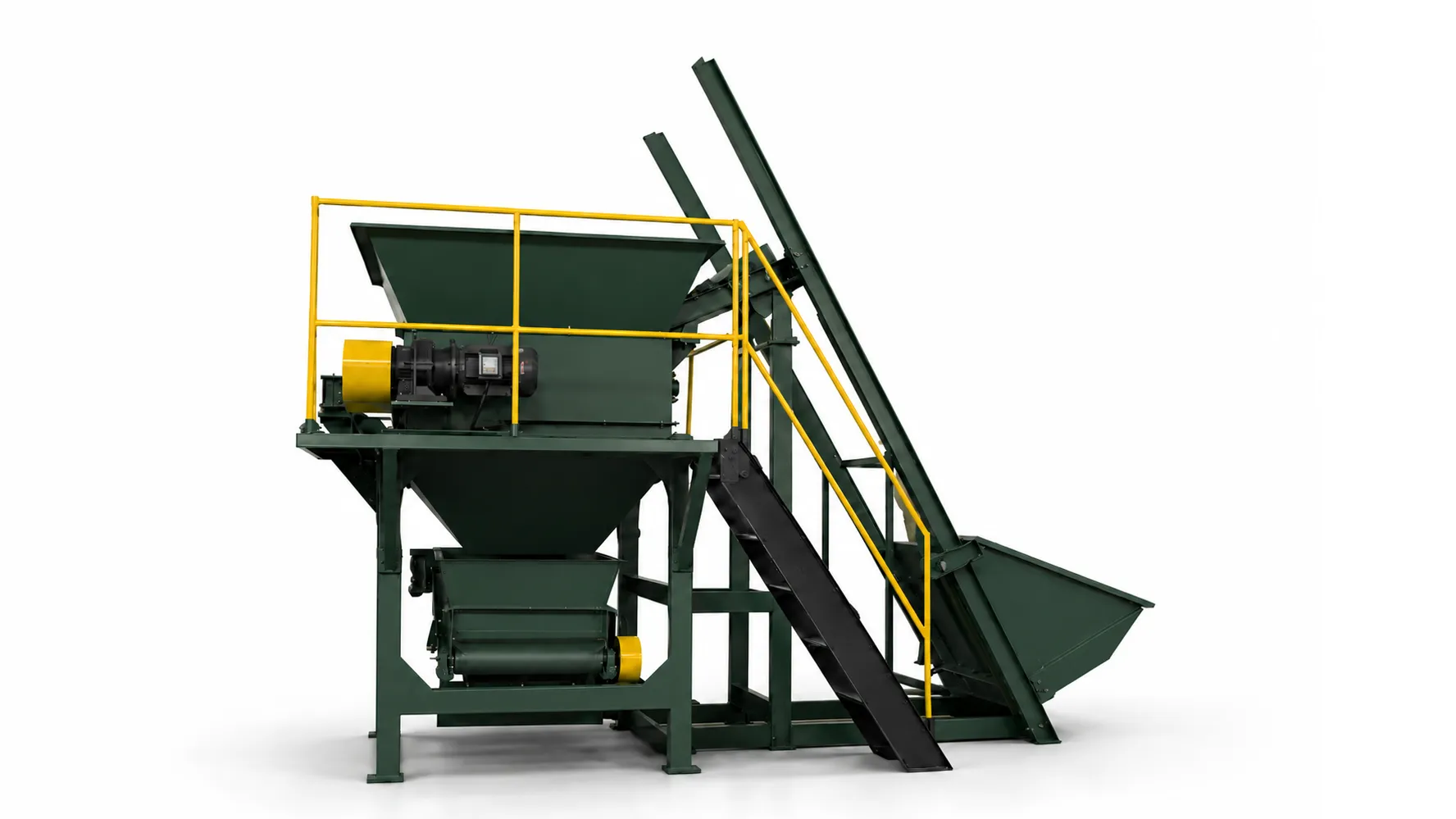
What Each Machine Actually Does
A hydraulic guillotine cutter is a slicing machine. The bale is positioned under a heavy blade, and hydraulic pressure drives the blade down through the compressed block in a single stroke, cutting it into slabs. Wires are cut in the same pass. Its output is not small pieces — it is manageable sections that fall apart into loose material a conveyor and shredder can handle.
A shredder is a tearing machine. Rotating knives grab, rip, and reduce material to a controlled output size through a screen. It is the right tool for size reduction — but feeding it whole bales means the rotor meets a solid block instead of a stream. Current spikes, knife wear accelerates, film wraps the shaft, and throughput collapses to whatever the operator can force in.
| Guillotine Cutter | Shredder | |
|---|---|---|
| Job | Slice bales and dense blocks into slabs; cut bale wires in the same stroke | Tear material down to a defined particle size |
| Output | Loose sections ready for conveying and shredding | Uniform flakes or chunks, sized by the screen |
| Weakness | Does not size-reduce; slabs still need a shredder or crusher after it | Whole bales overload it: current spikes, rapid knife wear, film wrapping |
| Best feed | Compressed film bales, bottle bales, fiber and big-bag bales | Loose or pre-cut material at a steady feed rate |
It Is Usually Not Either/Or
On a well-run line the sequence is: open the bale, pre-cut it, then shred. Bale opening itself may be handled by a dedicated debaler — Rumtoo's debaler machines for PET bottle recycling loosen compressed bottle bales at the head of the line — with a guillotine cutter taking over where bales are too dense or wire-bound to pull apart mechanically. The shredder then receives slabs and loose material at a rate it was designed for, and its knives last the intervals they were supposed to.
- Loose film, loose bottles, production scrap — shredder alone is fine; skip the cutter
- Wire-tied film or fiber bales — guillotine pre-cutting pays for itself in shredder knife life
- Dense PET bottle bales — debaler or guillotine first, then shredder; never whole bales straight into the rotor
- Mixed bales with unknown contents — cutting slabs first also gives operators a chance to spot contaminants before they reach the blades
And the bale itself was made somewhere: if your plant also bales its own output or residues for transport, bale density and wire pattern are choices, not accidents. The comparison data on Rumtoo's baler machines — press forces from 30 to 100 tons and bale sizes across the range — shows how much bale density varies; the denser the bale you buy or make, the stronger the case for a cutter at the intake.
Tell us your bale material, bale size, and how the line is fed today. We will map the right intake sequence — debaler, guillotine cutter, shredder — for your throughput.
See Debaler Machines


Comments
Post a Comment