Small Plastic Bottle Shredder: The Smart Solution for Everyday Plastic Waste
Plastic bottles pile up in offices, schools, laboratories, hotels, and small factories — not in tonnes, but steadily, every day. They are too bulky to store, too light to transport economically, and far below the volume that justifies an industrial shredding line. A small plastic bottle shredder fills that gap: a compact machine that reduces PET bottles and small containers to flakes at the point where the waste is generated. This guide explains what these machines can and cannot do, the specifications that matter, and how to judge whether one fits your site.
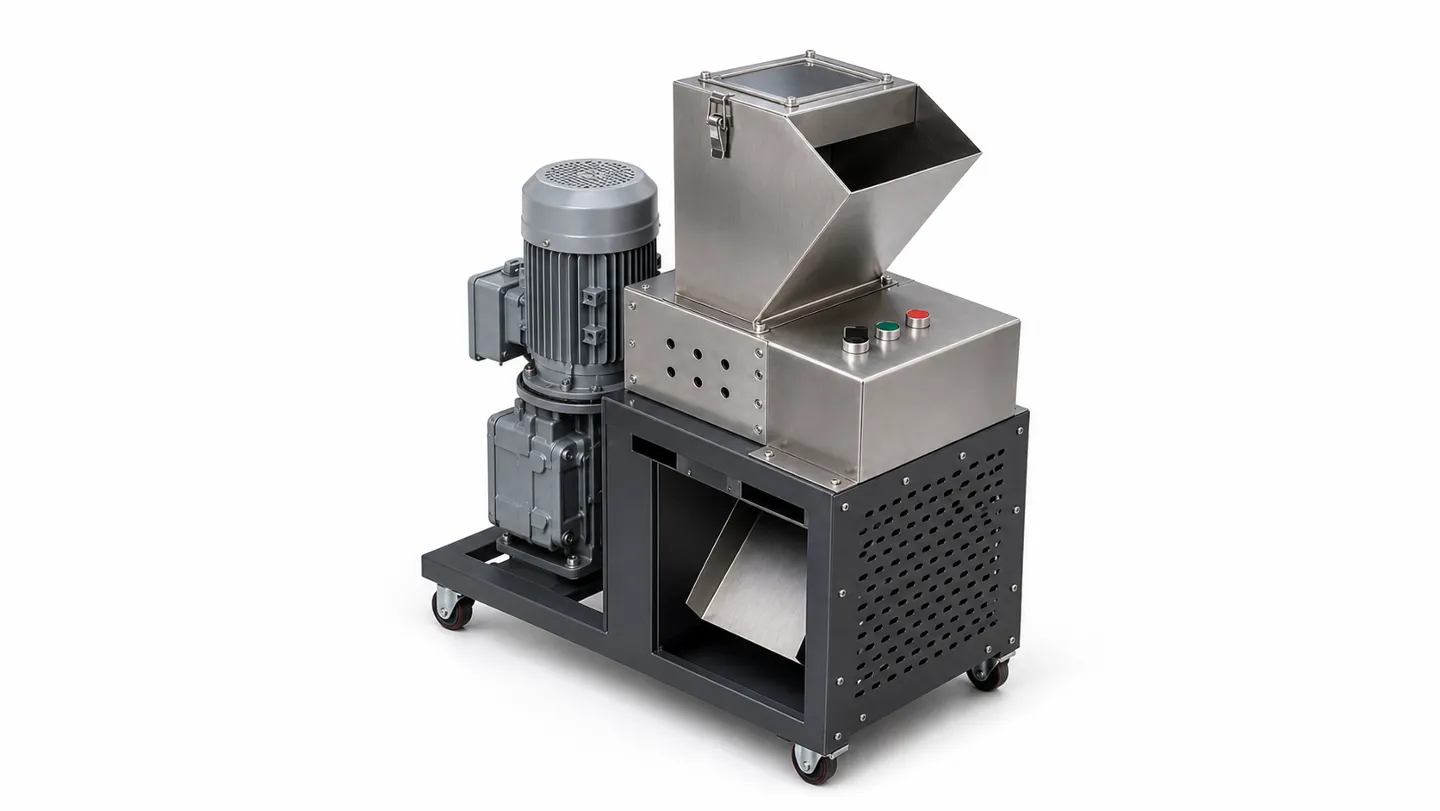
What a Small Bottle Shredder Is — and Is Not
A small bottle shredder is a low-speed, high-torque cutting machine sized for intermittent, small-batch work. It takes whole PET bottles and similar small rigid containers and cuts them into flakes that take up a fraction of the storage space, are cheaper to move, and are ready for washing or direct sale to a recycler. It is not a toy office appliance, and it is not a substitute for an industrial granulator on a production line. The honest way to evaluate one is by its cutting components and drive — the same criteria as a big machine, at a smaller scale.
Specifications That Matter (RTMS-C120 as the Reference)
| Parameter | RTMS-C120 |
|---|---|
| Throughput | Up to 20 kg/h (material-dependent) |
| Motor | 1.5 kW geared motor |
| Blades | H13 tool steel; blade sets for approx. 5 mm or 3 mm output |
| Feed opening | 120 × 200 mm |
| Power supply | 220 V standard; 120 V available for North American sites |
| Dimensions / weight | 650 × 300 × 780 mm; 101 kg |
| Protection | Automatic forward/reverse — the rotor backs out of a jam instead of stalling |
Three of these lines decide real-world usefulness. The geared motor delivers the low-speed torque that lets a 1.5 kW machine bite through bottle walls and caps without stalling. H13 blades are a genuine tool steel, not the stamped mild steel of novelty shredders, and they can be resharpened. And auto-reverse is what keeps a small machine running unattended between other tasks — it clears overloads itself instead of waiting for an operator with a wrench.
Where a Compact Shredder Earns Its Place
- Offices, schools, and hotels — volume reduction at source; flakes instead of rooms full of bagged bottles
- Laboratories and R&D — preparing controlled flake samples, destroying prototypes and branded packaging
- Small production sites — regrinding rejects and start-up scrap in-house instead of paying to haul air
- Community and municipal collection points — densifying collected bottles before transport to a central recycler
Rumtoo's mini compact shredder is built for exactly this duty class — the same machine platform is also used for 3D-printing waste and laboratory material preparation, which is why the feed opening and blade options are sized for small, controlled batches rather than bulk feeding.
Small Shredder or Industrial Model? A Straight Comparison
Choose the compact machine when your daily volume is measured in bags, not bales; when floor space is a corner, not a hall; and when one operator feeds it between other duties. Choose an industrial crusher or shredder when material arrives by the tonne, when you need continuous 24-hour running, or when the feedstock includes thick-walled containers, pipes, or lumps. The mistake to avoid is buying the compact class for an industrial job because the price is attractive — throughput is a physical limit, not a settings page.
Send your material, daily volume, and site voltage. We will confirm whether the RTMS-C120 class fits, or tell you honestly if you need the next size up.
See the Mini Compact Shredder


Comments
Post a Comment