How to Recycle Styrofoam: A Guide for Industry Professionals
"Styrofoam" — properly expanded polystyrene, or EPS — is an excellent packaging and insulation material and an awkward waste stream. It protects products superbly precisely because it is mostly air, and that same property makes it expensive to store, transport, and landfill. This guide explains how industrial EPS recycling actually works: densification with a cold press machine, what happens to the blocks afterward, and the business case for doing it in-house.
Why EPS Is Difficult to Recycle
The problem is economics, not chemistry. EPS is roughly 98% air, so a truckload of loose foam contains very little actual plastic by weight — transport and landfill gate fees are effectively paid on air. Loose foam also blows around collection sites, contaminates other recycling streams, and is refused by many material recovery facilities. Any practical recycling route therefore has to solve the volume problem first. That solution is densification.
The Solution: Densification with an EPS Cold Press
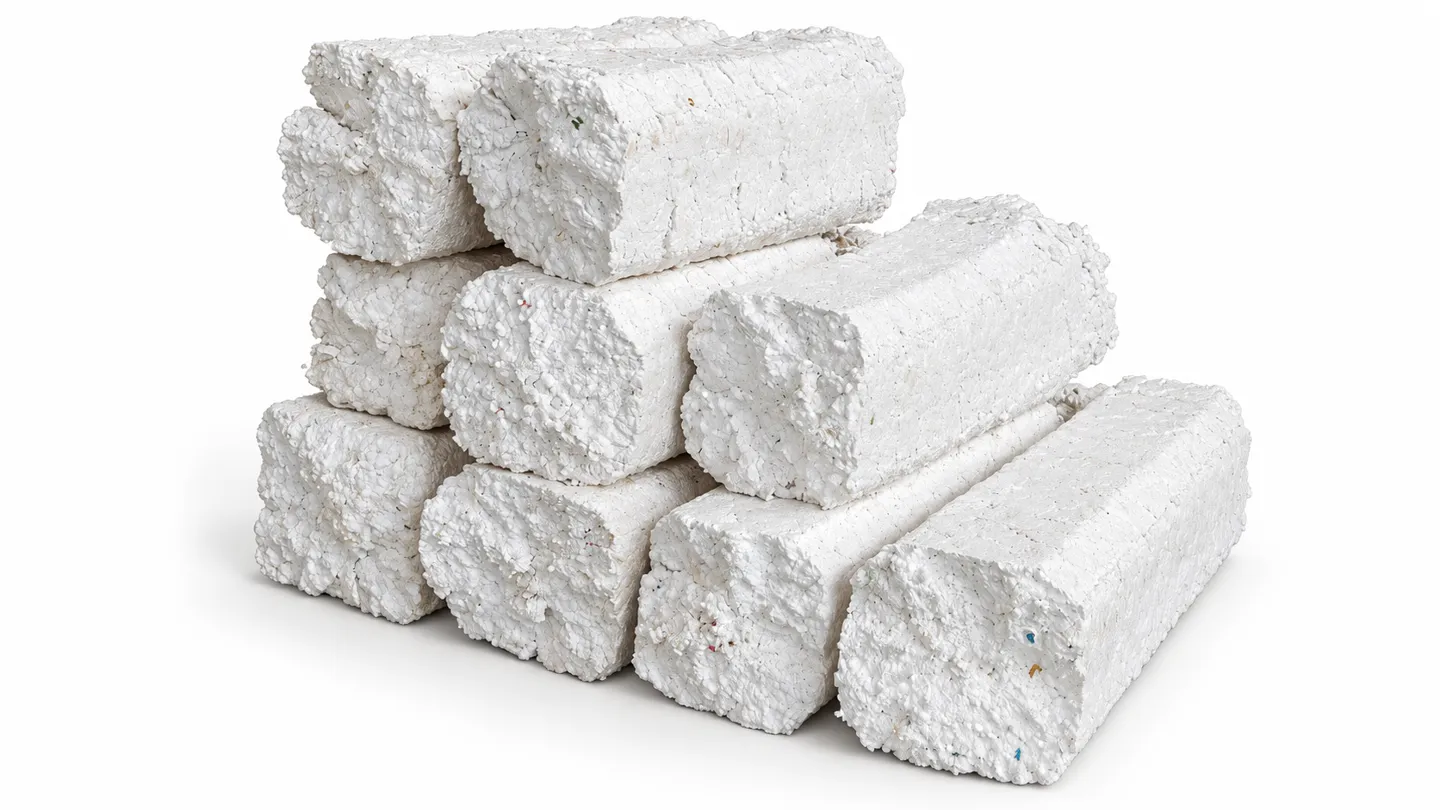
An EPS foam cold press machine crushes the foam and then compacts it with screw pressure into dense, stackable blocks — with no heater and no melting stage. "Cold" describes the compaction method: the foam is squeezed mechanically until the cell structure collapses and the block holds together for handling and palletizing. The achieved volume reduction varies with the starting foam density, contamination, and feeding consistency, which is why honest sizing starts with your actual foam, not a catalogue ratio.
| Model class | Throughput | Typical fit |
|---|---|---|
| RTM-CP50 | 40–50 kg/h | Modest daily volumes, single-operator loading (612 × 500 mm feed opening) |
| RTM-CP100 | 80–100 kg/h | A full shift of steady feeding (1,000 × 600 mm opening) |
| RTM-CP200 | 150–200 kg/h | Collection centers and foam processors with palletized block handling |
From Compacted Blocks to New Products
Densified blocks are a tradable commodity: they are sold to recyclers who reprocess them into polystyrene pellets. Those pellets go back into manufacturing as picture frames, moldings, coat hangers, stationery, and new insulation board. The chain only works because densification made the first step — getting the foam from your floor to the recycler — economically sane.
The Business Case
- Disposal cost avoided — every compacted block is loose volume that never enters a skip or a landfill truck
- Transport efficiency — dense pallets replace truckloads of air, cutting cost per kilogram shipped
- Revenue instead of fees — clean, consistent blocks command a price from PS recyclers
- Compliance and reporting — a documented recycling route for a material customers and regulators increasingly ask about
Send foam photos and your daily processing target. Rumtoo will match an RTM-CP cold press configuration to your actual stream.
Read the EPS Cold Press Buyer's Guide


Comments
Post a Comment