Fiber Shredders: Transforming Textile Waste into a Sustainable Resource
Textile waste is bulky, soft, tangled — and expensive to landfill. Garment factories produce cutting offcuts by the bale, carpet recyclers deal in rolls that will not fit any standard hopper, and nonwoven producers generate continuous streams of edge trim. None of it can be recycled, baled efficiently, or even transported at sensible cost until it has been shredded. This article explains what a fiber shredder does differently from a standard plastic shredder, and how to judge one for textile duty.
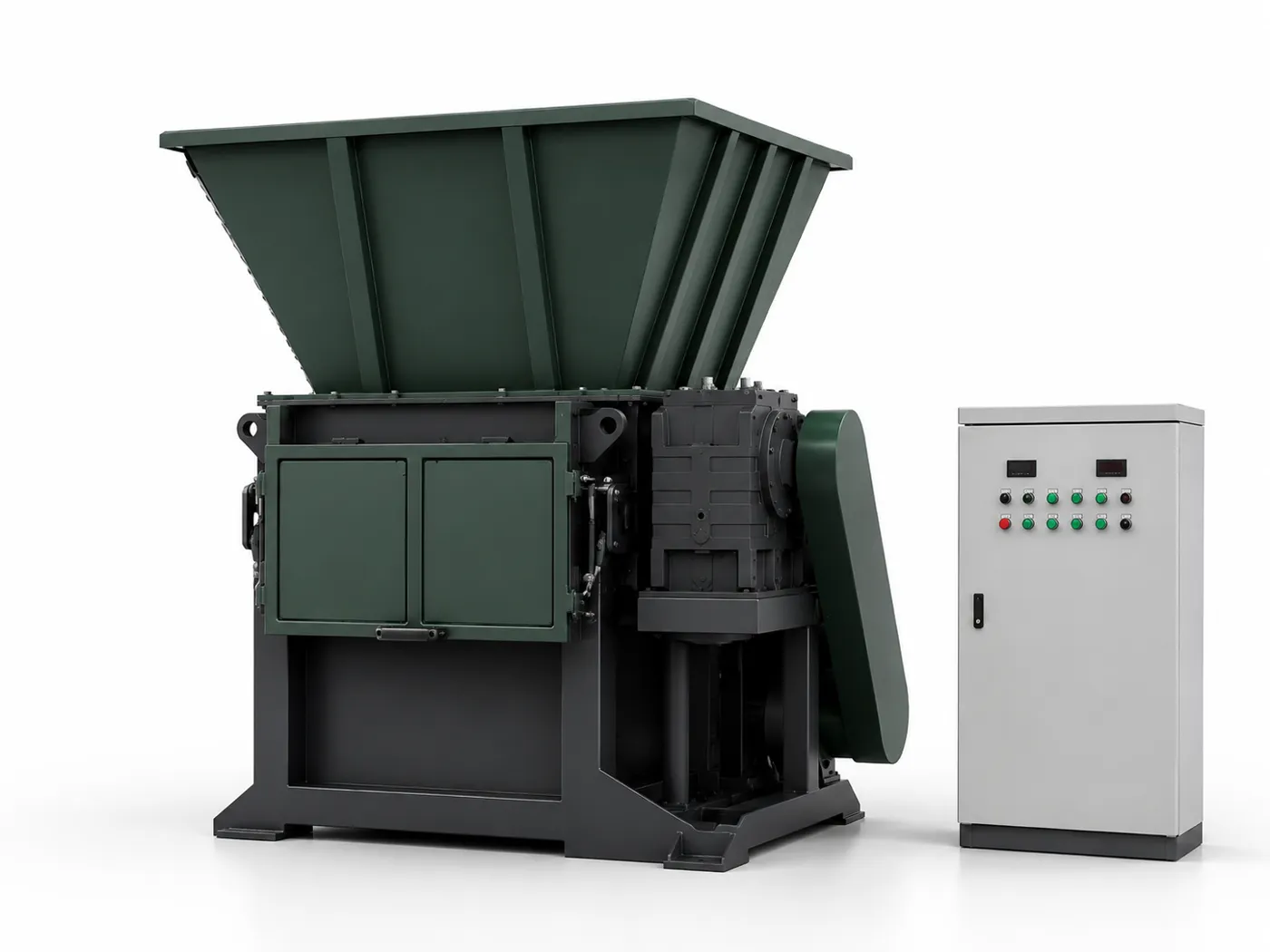
Why Fibrous Material Defeats Standard Shredders
Rigid plastic breaks. Fabric does not — it stretches, wraps, and mats. Fed into a machine designed for hard lumps, long fibers wind around the shaft until torque collapses, layered material bridges over the cutting chamber, and soft fluffy feed simply rides on top of the rotor without being drawn in. A fiber shredder is engineered around those three failure modes: knife and shaft geometry configured for fibrous and layered streams, a feeding response that pulls irregular, tangled input down consistently, and protection logic that reverses or stops the rotor on overload before a jam becomes a stoppage.
What the Machine Handles
- Garment and factory waste — cutting offcuts, selvedge, rejected fabric, sewing thread waste
- Carpet and flooring — carpet tiles, broadloom offcuts, underlay
- Nonwovens — production edge trim, off-spec rolls, hygiene-product scrap
- Fiber scrap — yarn, rope, woven sacks and FIBCs, upholstery waste
- Post-consumer textiles — clothing and household fabrics prepared for sorting and recovery
Shredded output goes on to denser baling and transport, refuse-derived fuel, insulation and shoddy production, or further recycling steps — in every case at a fraction of the original volume. Rumtoo's textile and fibre shredder is specified for these streams, and the same cutting platform is offered for carpet duty as a textile and carpet waste single shaft shredder.
Reference Specification
| Parameter | Typical configuration |
|---|---|
| Applications | Textile waste, nonwoven fabric, fiber scrap, trimming waste |
| Output capacity | About 300 kg/h (material-dependent) |
| Blade material | SKD-11 alloy steel |
| Shaft | Tempered 45 steel, anti-winding configuration |
| Protection | Overload protection with jam-reversing function |
| Drive | Direct-drive, high-torque transmission for energy efficiency |
Choosing a Fiber Shredder: Four Checks
1. Longest fiber in your stream. Yarn, rope, and carpet backing are the winding worst cases — confirm the anti-winding design against your actual material, ideally with a trial run. 2. Blade metallurgy. Textile waste carries zippers, buttons, and grit; SKD-11-class blades hold an edge where mild steel folds. 3. Service access. Blade changes are routine on abrasive streams, so a design that simplifies blade replacement is worth more than a marginal capacity advantage. 4. Downstream form. Decide the output size your next step needs — baling, fuel preparation, and fiber recovery each want a different shred.
Tell us the material — offcuts, carpet, nonwoven trim — and your target output. We will configure a fiber shredder for your stream, with a trial run where practical.
See the Textile & Fibre Shredder


Comments
Post a Comment